
Most small businesses think influencer marketing is only for brands with huge budgets. It’s not. This guide shows you exactly how to find the right creators, what to pay them, and how to track every dollar — even if you’re starting with $200.
In this guide:
- What is influencer marketing and how does it work for small businesses?
- Why influencer marketing is perfect for small businesses in 2026
- Types of influencers — which tier fits your budget?
- How to find micro influencers for your business in 2026
- How much does influencer marketing cost? (2026 pricing guide)
- How to reach out to influencers (with templates)
- Running your first influencer campaign: a step-by-step playbook
- How to measure ROI from influencer marketing
- 7 costly mistakes small businesses make (and how to avoid them)
- Frequently asked questions
What is influencer marketing and how does it work for small businesses?
Influencer marketing is a strategy where brands partner with content creators — people who have built a loyal, engaged audience on social media platforms like Instagram, TikTok, YouTube, or LinkedIn — to promote their products or services.
For a small business, it works like this: instead of spending thousands on Google Ads or Facebook campaigns that feel impersonal and get ignored, you pay a trusted voice in your niche to introduce your brand to their audience. Because that audience already trusts the creator, the recommendation lands completely differently than a traditional ad.
“92% of consumers trust influencer recommendations over traditional advertisements.”— Nielsen Consumer Trust Index
The key word is trust. When a local fitness creator with 8,000 TikTok followers tells her audience that your protein powder changed her morning routine, those 8,000 people hear it from a friend — not a corporation. That’s the fundamental power shift that makes influencer marketing so effective for small, independent businesses.
Key Takeaway
Influencer marketing lets small businesses borrow the trust that creators have already built with their audiences — without spending years building that trust themselves.
Why influencer marketing is perfect for small businesses in 2026
Three years ago, influencer marketing was dominated by large brands writing six-figure checks to celebrities. That world is gone. In 2026, the economics have completely flipped in favor of small businesses — here’s why.
Traditional ads are getting more expensive and less effective
The average cost-per-click on Meta ads has risen steadily, while click-through rates continue to decline as people develop “banner blindness.” Small businesses are competing against enterprise marketing budgets for the same audience slots. Meanwhile, ad blockers are used by over 42% of internet users globally.
Nano and micro influencers are the ROI sweet spot
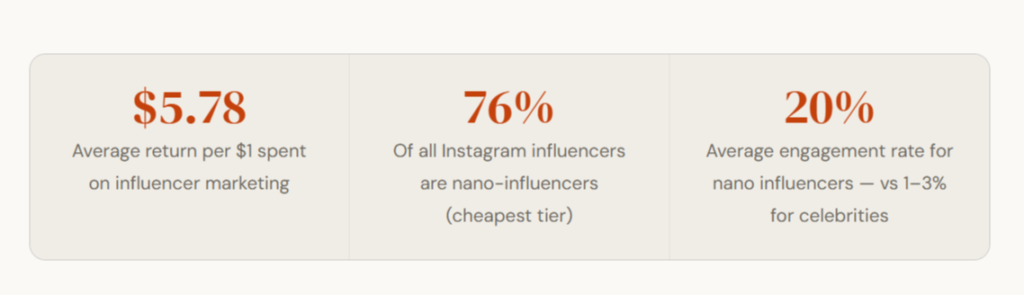
The biggest creators — celebrities and mega influencers with millions of followers — charge enormous fees and often deliver surprisingly low engagement. Meanwhile, nano influencers (1K–10K followers) routinely achieve engagement rates of 5–20%, compared to just 1–3% for celebrity accounts. For a small business, working with 5 nano influencers at $50 each will almost always outperform one macro influencer at $1,000.
The industry is now worth $34 billion — but accessible to all
The global influencer marketing industry is projected to surpass $34 billion in 2026. But what matters for small businesses is that the tools, platforms, and creator ecosystems now make it possible to launch professional campaigns for as little as $200 a month. The barrier to entry has never been lower.
Consumers are buying through social media, not just browsing
TikTok Shop alone is projected to hit $20–23 billion in US sales in 2026. Social commerce has crossed from “emerging trend” to mainstream buyer behavior. Small businesses that build creator relationships now are positioning themselves at the front of this wave.
Small businesses are uniquely positioned to offer influencers something big brands can’t: authentic stories, flexible partnerships, and genuine relationships. Creators often prefer working with independent businesses over faceless corporations.
Types of influencers which tier fits your budget?
Understanding influencer tiers is the first practical step. Each tier has different characteristics, pricing, and use cases. For most small businesses, the sweet spot is nano and micro influencers.
| Tier | Follower Range | Avg. Engagement | Typical Cost / Post | Best For |
|---|---|---|---|---|
| Nano | 1K – 10K | 5–20% | $10 – $100 (or gifting) | Hyper-local, niche, budget-first campaigns |
| Micro | 10K – 100K | 3–8% | $100 – $500 | Niche audiences, strong trust, proven content |
| Mid-tier | 100K – 500K | 1.5–3% | $500 – $5,000 | Scaling reach, brand awareness campaigns |
| Macro | 500K – 1M | 1–2% | $5,000 – $20,000 | Mass awareness — rarely worth it for SMBs |
| Mega / Celebrity | 1M+ | 0.5–1% | $20,000+ | Not recommended for small businesses |
The data is clear: bigger is not better when it comes to influencer marketing for small businesses. A nano influencer with 5,000 highly engaged followers in your niche will consistently outperform a celebrity with 2 million passive followers. The purchase intent is higher, the audience fit is tighter, and the cost is a fraction.
How to find the right influencers for your business
Finding the right influencer is the single most important decision in your campaign. A perfect product-creator match with 3,000 followers will outperform a bad match with 300,000 followers every time. Here are the five best methods small businesses use to find quality creators.
Method 1: Use an influencer marketing platform
The fastest and most reliable way to discover vetted creators is through a dedicated influencer platform like Influensca. On Influensca, both brands and creators register on the platform, and every creator profile is carefully reviewed by our team to ensure quality and authenticity. We then match creators with brands based on key factors such as niche, location, audience demographics, follower count, and engagement rate helping you find the perfect fit in minutes instead of spending days searching manually.
Method 2: Search hashtags on Instagram and TikTok
Search hashtags directly related to your product or industry. If you sell artisan coffee, search #specialtycoffee, #coffeeroaster, or #morningcoffeeritual. Look for creators who are posting consistently, getting meaningful comments (not just emoji reactions), and who don’t already have thousands of brand posts — that’s a sign they’re still selective.
Method 3: Search who’s already talking about you
Check your brand’s tags and mentions on Instagram, TikTok, and Twitter. Customers who already love your product and post about it organically are your warmest possible influencer leads. They’re authentic, they already believe in what you sell, and outreach to them feels natural rather than transactional.
Method 4: Google for bloggers and creators in your niche
Search “[your niche] + blogger” or “[your city] + content creator” on Google. Many creators maintain blogs or websites alongside their social channels. A local food blogger in your city who posts to 8,000 Instagram followers could be one of your best marketing investments of the year.
Method 5: Look at your competitors
Check who your competitors are tagging or being tagged by on their social profiles. The creators they’ve worked with are already proven fits for your niche and if the partnership felt purely transactional, they might be open to working with a brand that offers a more authentic relationship.
Red Flags to Avoid
Watch out for: sudden follower spikes with no content change (bought followers), engagement that’s almost entirely from other influencers or generic accounts, follower to following ratios that are nearly 1:1 (follow for follow accounts), and comment sections full of emoji only responses or obvious bots.
What to look for when evaluating an influencer
- Engagement rate above 3% (for micro influencers) or 5% (for nano influencers)
- Comments that are genuine conversations, not just “Great post!” or emojis
- Content that aligns authentically with your brand not just a niche label
- A consistent posting schedule (at least 2–3 posts per week)
- Audience demographics that match your customer profile (use the platform’s analytics tools)
- No history of controversial content that could reflect on your brand
- They haven’t posted sponsored content for 5+ competing brands in the last month
How much does influencer marketing cost? (2026 pricing guide)
One of the biggest misconceptions about influencer marketing is that it requires a large budget. The reality: you can start meaningful campaigns with as little as $200–$500 per month and scale from there based on what’s working.
The four pricing models you need to know
| Model | How It Works | Best For | Average Cost |
|---|---|---|---|
| Product Gifting | Send free products in exchange for content — no cash changes hands | New businesses, nano influencers | Cost of goods only |
| Flat Fee | Pay a fixed rate per post, video, or story | Most small business campaigns | $10–$500 per post |
| Affiliate / Commission | Creator earns a % of sales they generate via a unique link or code | E-commerce brands, performance-focused | 5–20% commission per sale |
| Hybrid | Small flat fee + affiliate commission | Ongoing partnerships, brand ambassadors | $50–$150 flat + 10–15% commission |
Realistic starter budgets by business size
Brand new / bootstrapped ($0–$200/month): Focus entirely on product gifting. Send your product to 5–10 nano influencers per month. Provide clear but flexible creative direction. Track results via coupon codes. Many successful brands have grown entirely on gifting campaigns before introducing paid fees.
Small business / side hustle ($200–$500/month): Run a 30-day pilot with 3 nano or micro influencers. Budget roughly $150–$200 per creator for a campaign including 2 posts and 3 stories. Track ROI carefully and double down on whoever drives the most traffic or sales.
Growing business ($500–$2,000/month): Work with a consistent roster of 4–8 micro influencers on a monthly retainer model. This creates content volume and consistent brand exposure, while giving creators time to authentically integrate your brand into their content style.
Money-Saving Strategy
The highest-ROI approach for most small businesses in 2026 is an affiliate-first model: offer creators a generous 15–20% commission instead of a large flat fee. This aligns your incentives with theirs — they’re motivated to actually drive conversions, not just post and collect a check.
How to reach out to influencers (with templates)
Your outreach message is your first impression. Most brands send cold, generic DMs that get ignored. Here’s how to write outreach that actually gets responses.
The 4 rules of effective influencer outreach
- Make it clear you know their work — reference a specific post or topic they cover
- Be upfront about what you’re offering (free product, flat fee, commission, or a combination)
- Keep it short — under 100 words for a first DM; under 200 words for a first email
- Always end with a clear, easy call to action (“Does this sound interesting? Happy to share more details.”)
Response Rate Tip:
Email outreach consistently gets higher response rates than DMs for business proposals. If the creator has an email in their bio, always lead with email. Follow up with a brief DM 4–5 days later if no response.
Running your first influencer campaign: a step-by-step playbook
Follow these steps in order.
1. Define your goal before you do anything else
Pick one primary goal: brand awareness (reach, impressions), community growth (new followers), or direct sales (clicks, conversions). Every decision that follows — which influencer to choose, what content to ask for, how to measure success — flows from this single choice. Campaigns that try to do everything at once typically do nothing well.
2. Set your budget and pricing model
Decide your total monthly budget and whether you’re leading with gifting, flat fees, affiliate commissions, or a hybrid. For first campaigns, we recommend starting with gifting or a small hybrid offer to minimize financial risk while you learn which creator types work best for your brand.
3. Find 5–10 candidate influencers
Use an influencer platform or the manual discovery methods above to build a shortlist of 5–10 creators. Vet each one for engagement quality, audience fit, and content authenticity. You’ll likely move forward with 3–5 from this list after your outreach phase.
4. Send outreach and negotiate terms
Contact your shortlist using the templates above. Clearly state what you’re offering and what you’d like in return (content deliverables, posting dates, usage rights). Respond promptly — creators work with multiple brands and a slow reply loses the partnership. Once terms are agreed, send a simple written agreement to both parties by email.
5. Write a creative brief but give freedom
A brief should cover: your brand story (2–3 sentences), key product benefits, any required mentions (hashtag, @tag, disclosure), posting deadline, and what you absolutely cannot show (competitors, etc.). What it should NOT include: a word-for-word script. Audiences can smell scripted influencer content immediately. The best briefs give direction, not dictation.
6. Give each creator a unique tracking link or code
Create unique UTM links for each creator using Google’s Campaign URL Builder, or assign each creator a unique discount code. This is non-negotiable for measuring ROI. Without tracking, you’ll never know which creators are actually driving results — and you’ll be flying blind on future budget decisions.
7. Monitor, engage, and amplify
When content goes live, engage with it immediately — like, comment, and share it on your own accounts. This signals to the platform’s algorithm that the content is valuable, helping it reach more people. Save top-performing content for repurposing in your own social feed, email newsletter, or as paid ad creative.
8. Analyze results and build relationships with top performers
After the campaign window (typically 2–4 weeks), review your tracking data. Which creator drove the most traffic? The most sales? The highest engagement? Double down on those creators with a repeat or ongoing partnership offer. A long-term relationship with one creator who converts is worth more than a rotating cast of one-off deals.
Ready to find your first influencer?
Infuesnca makes it easy to discover, connect with, and manage nano and micro influencers — starting for free. Start Free on Infuesnca →
How to measure ROI from influencer marketing
Measurement is where most small businesses fall short. Without clear tracking, you can’t tell the difference between a campaign that’s silently working and one that’s quietly burning your budget. Here’s how to measure every dollar.
Primary metrics to track
| Goal | Metrics to Track | How to Track |
|---|---|---|
| Sales / Conversions | Revenue, orders, conversion rate | Unique promo codes, UTM links in GA4 |
| Website Traffic | Clicks, sessions, bounce rate, time on site | UTM links → Google Analytics 4 |
| Brand Awareness | Reach, impressions, brand searches | Creator dashboard screenshots, Google Search Console |
| Engagement | Likes, comments, shares, saves | Creator provides post insights; track manually |
| New Followers / Audience | Follower growth on campaign days | Compare follower count before/after go-live |
How to calculate your influencer marketing ROI
ROI Formula
ROI = (Revenue Generated − Campaign Cost) ÷ Campaign Cost × 100
Example: You spend $400 on an influencer campaign (2 creators × $200 each). The campaign drives $1,800 in tracked sales via promo codes. ROI = ($1,800 − $400) ÷ $400 × 100 = 350% ROI.
Industry benchmarks suggest that businesses earn an average of $5.78 for every $1 spent on influencer marketing. Your first campaigns may not hit that number — but by consistently tracking and optimizing toward your best performers, most small businesses reach or exceed it within 3–4 campaign cycles.
Influencer content has a long tail. A TikTok video can continue driving traffic for weeks or months after posting. Track website traffic from your UTM links for 30–60 days after go-live before making final ROI judgments on a campaign.
7 costly mistakes small businesses make and how to avoid them
These are the errors that waste the most money. Each one is easy to avoid once you know about it.
1. Choosing influencers based on follower count alone
A creator with 50,000 disengaged followers will underperform a creator with 4,000 passionate, niche followers every single time. Always prioritize engagement rate and audience fit over raw numbers.
2. Running one campaign and calling it a failure
Influencer marketing, like all marketing, requires consistency. Audiences need to see a brand multiple times before they take action. A single post rarely delivers meaningful conversion. Plan for at least 3 months of consistent partnerships before making a judgment call.
3. Overscripting the content
Audiences immediately recognize inauthentic, scripted influencer content — and they tune it out. Give creators a creative brief, not a screenplay. The best performing influencer content sounds like the creator’s own voice, not a brand’s press release read aloud.
4. Not tracking results with unique links or codes
Sending free product without a tracking mechanism means you’ll never know if the campaign worked. Always use unique discount codes or UTM-tagged links. This is a five-minute setup that transforms your campaigns from guesswork to data-driven decisions.
5. Ignoring FTC disclosure requirements
In the United States, all paid partnerships must be disclosed clearly — #ad, #sponsored, or “paid partnership” in the first line of the caption. Require your creators to include this in every piece of sponsored content. Non-compliance can result in fines for both the brand and the creator.
6. Only measuring immediate sales
Some campaigns build brand awareness that converts weeks or months later. Customers may see an influencer post, visit your site, leave, and return later via Google search. Track your brand search volume and website traffic trends across the full campaign period, not just the conversion data from Day 1.
7. Not repurposing influencer content
When a creator makes great content featuring your product, that content has value far beyond the original post. With usage rights negotiated upfront (always do this), you can repurpose the best influencer content as paid social ads, email campaigns, website photography, and organic social posts — dramatically increasing the ROI of every dollar you spend.
Frequently asked questions
How much does influencer marketing cost for small businesses?
Influencer marketing for small businesses can start for as little as $0 using product gifting and barter deals. Nano influencers (1K–10K followers) typically charge $10–$100 per post, while micro influencers (10K–100K followers) charge $100–$500 per post. A realistic starting budget is $200–$500/month for a small business testing its first campaigns.
How do small businesses find influencers?
Small businesses can find influencers through dedicated platforms like Infuesnca, Instagram and TikTok hashtag searches relevant to their niche, Google searches for bloggers in their industry, and by looking at who is already organically mentioning or tagging their brand on social media.
Is influencer marketing worth it for small businesses?
Yes. On average, businesses earn $5.78 for every $1 spent on influencer marketing. For small businesses specifically, nano and micro influencers offer the best ROI, with engagement rates of 5–20% compared to 1–3% for celebrity influencers. Small businesses often see faster results because they can work with hyper-local creators who speak directly to their target audience.
What type of influencer is best for a small business?
Nano influencers (1K–10K followers) and micro influencers (10K–100K followers) are the best fit for most small businesses. They are affordable, have highly engaged niche audiences, and are more willing to collaborate with smaller brands. Their audiences see them as trusted friends rather than paid celebrities, resulting in higher purchase intent.
Do I need a contract for influencer marketing?
For any paid partnership, yes — always have a written agreement. It doesn’t need to be a complex legal document, but it should clearly cover: the deliverables (what content, how many posts, on which platforms), the posting deadline, the compensation, the FTC disclosure requirement, and whether you have rights to repurpose the content. An email confirmation works for small gifting deals; a formal agreement is important for paid campaigns.
How long does it take to see results from influencer marketing?
Sales-focused campaigns can start showing results within 24–72 hours of a post going live, especially if the influencer shares a promo code or affiliate link. Brand awareness campaigns typically need 2–3 months of consistent activity before meaningful lifts in brand recognition or organic search traffic become measurable. Plan for at least 90 days before evaluating a full influencer marketing strategy.
What platforms work best for influencer marketing in 2026?
TikTok and Instagram remain the top platforms for most consumer brands. TikTok delivers exceptional organic reach and direct-to-purchase via TikTok Shop. Instagram is strongest for lifestyle, fashion, food, and beauty. YouTube is best for longer-form reviews and tutorials where purchase decisions require more education. LinkedIn is emerging as a powerful channel for B2B and SaaS businesses. Choose the platform where your target customers spend the most time.
Start small, track everything, double down on what works
Influencer marketing for small businesses is not about finding the biggest creator with the most followers. It’s about finding the right creator with the right audience — and building a real relationship that produces authentic content your future customers will trust.
Start with your budget, pick 3–5 nano or micro influencers in your niche, track every click and sale with unique codes and UTM links, and treat your first campaigns as a data-gathering exercise. Within 90 days, you’ll know exactly which creator types, content formats, and platforms drive results for your specific business.
Leave a Reply